
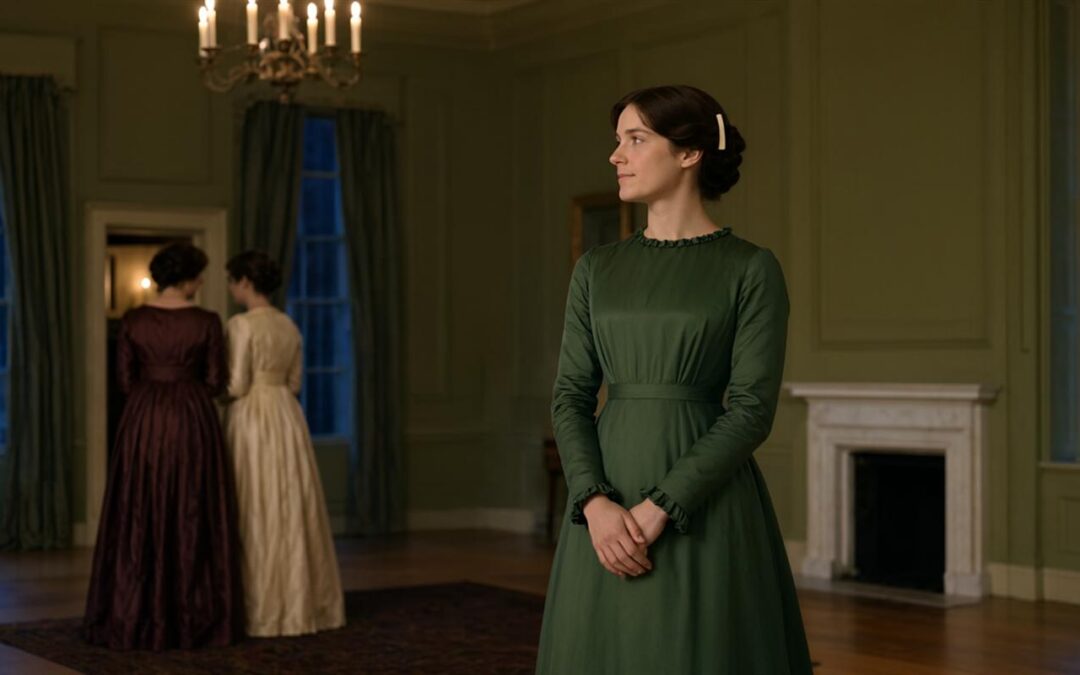
The Lark by Kate L. Hart is the first of four novels in Voices of Victorian Women, a quartet set in 1840s England and shelved under Women’s Historical Literature. Its heroine is Eva, the witty granddaughter of a philosopher, and the season that opens the book is her debut in the London Marriage Mart. She is quick, she is glad to be in town, and she is outshone at nearly every turn by a cousin who is both beautiful and titled. The people around her have plans for her future, and none of those plans begins with asking what she wants.
This page stays with that one novel. It covers what The Lark contains, what it is not, and whether it is likely to suit you. The reading order for all four books, and the wider map of Kate L. Hart’s two series, are separate questions with their own pages.
The Situation in The Lark: A Debut, a Family, and a Ledger
The London Season was the annual round of balls, dinners, theater visits and presentations through which families brought daughters into the marriage market, and the Marriage Mart was the wry name society gave that market. A debut was a public act. A young woman entered a room, and the room formed an opinion of her before she had said a word. Eva arrives with an opinion already attached: beside a cousin who is beautiful and titled, she is easy to overlook, and the catalog says as much. She is still eager for the season, and that eagerness is the one part of the arrangement that belongs to her.
Three pressures close around her at once. Her titled aunt assures her daily that she will end a spinster, which in that society was less a prediction than a verdict. Her uncle holds political aspirations, and a family’s reputation is currency in that pursuit. And her cousin is after Eva’s property through marriage. That last point deserves a line of context, because it reads as greed and works as arithmetic: under the property law of the period, a wife’s property came under her husband’s control, so an unmarried woman with means was, to her relatives, a transfer waiting to happen. This household is not simply fashionable. It is a set of competing accounts.
The Lark Book 1: A Title That Names a Game
The word lark has two ordinary senses in English. One is a frolic, a sprightly escapade, the sort of outing someone proposes on a whim. The other is the songbird that rises early and sings. The novel takes a colder third sense: a lark played against someone, a piece of business arranged by other hands. Its catalog description closes on two questions: what the lark being played against Eva amounts to, and who put her future up as an ante in the game. Those are useful questions to carry into the first chapter, because they say what kind of book this is. Not a courtship with obstacles. A courtship with interested parties.
Throughout, The Lark book 1 of the quartet keeps its tension indoors and in company. Later volumes move toward harder ground, the assault that shapes The Basra Pearls and the workhouse that runs through Tattered Silk, but this one stays in the drawing room. The danger is reputational and the weapon is attention. A duke meant for Eva’s cousin pays her too much of it, her aunt goes on the attack, and a side of life Eva had no idea existed comes into view. The book’s real subject is the moment a young woman works out that she has been a line item in someone else’s plan.
Eva: A Heroine Who Reads the Room
What Eva wants is easier to name than what she is permitted to want. She wants the season: the rooms, the company, the theater. Shakespeare runs at the Theater Royal for the whole of it, and the catalog lets her be delighted about that. The detail does more work than it first appears to. A young woman happiest at a play is a young woman who watches, and a watcher in a room full of performance is the one likeliest to notice when a performance is aimed at her.
What she is up against is a family that has already cast her. The beauty in the house belongs to her cousin, and the property in the house belongs to her, which is exactly why the cousin’s courtship reads as a transaction rather than a compliment. Her wit is the thing that keeps slipping out of the script, and wit in a woman with no fortune is a liability as often as it is a pleasure. When the duke’s attention lands on the wrong cousin and her aunt answers by attacking, Eva has to work out which of the people smiling at her are managing her. That answer is not available from the outside, and the novel’s suspense lives in the gap between what a room says and what a room is doing.
What The Lark Is Not and Who It Is For
A search for “The Lark Kate L. Hart” usually arrives with the same uncertainty: which of her books is this, and does it need to come after something else? It does not. The publisher’s note on the Books page is explicit that each of the four novels stands on its own, and that readers who want the series in order should begin here. The Lark is not one long story cut into four parts. It is the opening novel of four separate ones, and the women in the other three are not Eva.
It is also not the quartet’s book of hardship. The series reaches poverty and physical danger later, and a reader who wants that register from the first page should know it arrives in other volumes rather than expect it here. Because no page count and no format are published for the title, length is one thing this guide cannot settle in advance. What the catalog does publish is a price.
The reader who suits this book is the one who enjoys the season as a setting: calls and cards, rank and rivalry, conversation treated as a contact sport. It rewards your attention to who is speaking to whom, and why. A reader who wants peril, courtroom jeopardy or a workhouse ordeal will find those in the novels that follow, and the Voices of Victorian Women reading order sets out where each volume sits. A reader drawn to the catalog’s larger interest in repair, in people working out what is owed after something has gone wrong, will find that thread gathered in the catalog’s books about second chances and moral repair.
How to Read The Lark Alongside the Rest of the Series
The quartet comes from Jacob Marley Publications, an independent publisher working out of a home office in Kaysville, Utah, with fourteen titles on its list: two series and seven standalone works. The Lark is priced at $14.99, and its catalog card carries a Buy on Amazon link. Nothing in that arrangement asks a reader to commit to four books at once. The publisher’s note that each novel stands alone is the practical part of it: the quartet shares a period and a set of questions, not a plot.
The writer behind the quartet studied psychology as an undergraduate, with a minor in marriage and family relationships, and has seven books to her name. The About page adds that she places her characters in complicated relationships and explores how they find a healthy balance in life, which is a fair description of what happens in this novel’s drawing rooms. When the last page of The Lark turns, the next title in the numbering is High-Bred Rose, in which a maiden aunt named Myra comes home to find her niece courted by a man she sets out to stop. Her other series, The Reality Show, runs to three novels and has nothing to do with the 1840s.
For the wider picture, Kate L. Hart’s books across both series maps all seven titles and their order, and the catalog page listing every title’s price is the place to check before ordering. The background the catalog card leaves out, including the psychology degree the publisher credits for the complications her characters face, is in the publisher’s notes on its authors.
Key Takeaways
- The Lark opens Voices of Victorian Women, four self-contained novels set in 1840s England.
- Eva debuts in the London Marriage Mart outshone by a titled cousin, with an aunt predicting spinsterhood and a cousin angling for her property.
- The title’s lark is not a frolic but a game played by other hands, with her future as the stake.
- The pressure in this novel is social rather than physical; the series reaches poverty and danger in later volumes.
- Each of the four novels can be read on its own, and the catalog card carries the price and a buying link.
Conclusion
The Lark asks a reader to sit in a crowded room and watch a clever young woman work out who is arranging her life. That is a quieter pleasure than a chase or a scandal, and it is the reason to begin here rather than later: the season is at full volume, the family is at its most polished, and the game has not yet been named.
The practical facts are simple. The Lark by Kate L. Hart can be read without the others in the quartet, and its catalog card lists a price of $14.99. What it offers is a London season, a household with plans, and a heroine quicker than the people managing her. Whether that is the book you want this month is a question only the first chapter can answer.